Stretching Broken Crayons and a Brief Review of Handwriting Grasp Development

Stretching Broken Crayons and a Brief Review of Handwriting Grasp Development
grasp
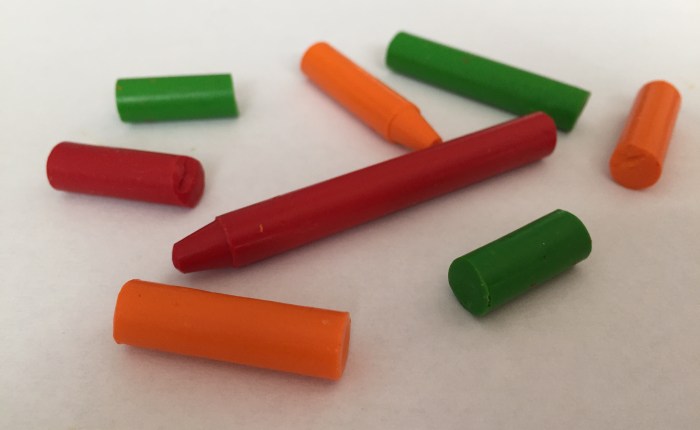
Every family has broken crayons in their house, but no one ever wants to use them and they end up being thrown out.  As a pediatric Occupational Therapist that specializes in writing and fine motor development, I want to share with you that broken crayons are actually some of the best tools to use to develop a proper handwriting grasp pattern

Continue reading “Stretching Broken Crayons and a Brief Review of Handwriting Grasp Development”

Stretching a deck of cards

cards

With the holidays coming up, I wanted to share some ideas about something almost everyone has in their home, despite possibly not having any children.  Whether you are going to visit aunts, grandparents, or friends, almost everyone has a Deck of Cards.

Many people think the only thing that you could do with the cards would be to teach them poker or play goldfish, but these are some other ideas, including some gross motor movement activities to help tire the kiddos out!

Quiet activities with a deck of cards:

Sorting the cards.  Sort the cards into card categories and put them in order numerically, by color, or by their suit.  Doing this activity will work on counting, sorting, visual motor, fine motor, dexterity, and organizational skills.

Shuffling the cards.  Teach your kiddos how to shuffle the cards.  You can go basic and show them how to pass out one card at a time, or go more advanced and show them how to actually shuffle and mix the cards together.  These activities work on fine motor coordination, dexterity, and hand strength which will help with handwriting.  Here is a link showing How to Shuffle cards.
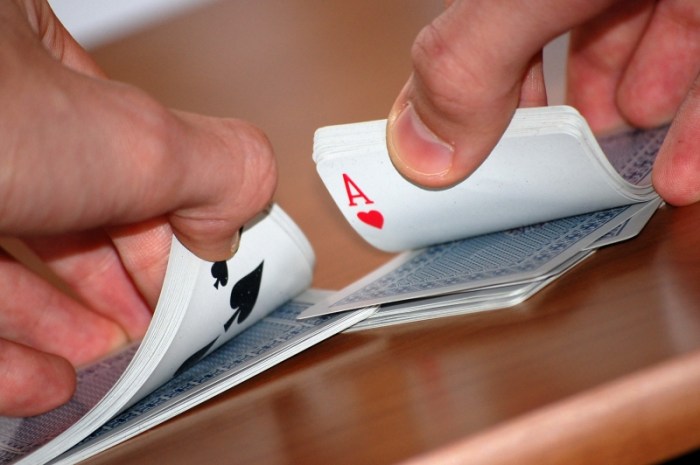
Shuffle-cards284

– Play simple card guessing games.  You can play simple guessing games with cards, like higher or lower, red or black, war, and go fish.  Doing these activities will increase interaction, participation, turn taking, fine motor skills, problem solving, and math skills.


Movement activities with a deck of cards:

-Counting movement activities with the cards.  Decide on a short movement activity (like high jumps, jumping jacks, leg kicks, or get the kids to make up there own movements).  Then whatever card they pick, that’s how many times they have to do it (you can use the face cards as breaks).  If you have 2 children you can assign one red and one black and if their card color comes up, they have to do it!  With this you can work on following directions, gross motor coordination, exercise, imaginative play, and it will hopefully tire them out a bit!
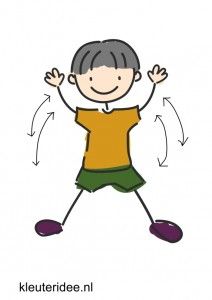
jumping jack

– 52 card pick up:  Everyone knows this game.  You just drop the cards on the ground and the kids have to pick them up.  Not many kids like to do this though, (I think it is because it is too much like clean-up time) but if you make it a game, you can get some great participation!  Have them pick them all up in categories like, 1 suit at a time, numerical order, or by color.  If you have multiple children, assign them something different, like one picks up the diamands and spades, and the other does hearts and clubs.  It adds an extra challenge that kids usually respond well to.  This activity can help with visual perceptual and visual motor skills, as well as counting, sorting, and fine motor skills.

– Hide and seek with the cards.  Hide cards in easy to find or harder areas around the room.  Kids have to go thru the room and find all 52! (Just be sure you have 52 to start.)  This works on motor planning, visual motor skills to visually perceptual skills, and counting.

Building a tower with cards.  This is a more advanced skill.  It will work on dexterity, fine motor control, visual motor skills, and patience.  Here is a link on how to build a tower with cards.
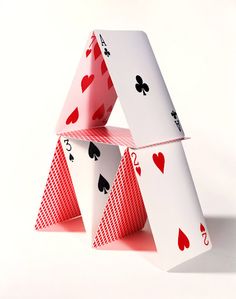
card tower

Michelle Higginson OTR/L Pediatric Occupational Therapist 

Biography

I’ve known for most of my life that I wanted to work with children, and turns out, I’m pretty good at it!  I completed my occupational therapy degree in 2003 and despite required internships in hospitals, nursing homes, and adult rehab units, I knew my heart was always in pediatrics!
To clarify what pediatric OT is, I work with children so they can perform their everyday tasks, or “their occupations.”  For them these are skills they need to play, feed, develop, and to take care of themselves.
The areas I focus on and am well versed in include:
~Sensory integration                 ~Handwriting
~Fine motor                                ~Prehensile patterns
~Visual motor                             ~Visual perceptual
~Early intervention                   ~Nuero-developmental treatment (NDT)
~Upper extremity splinting     ~Self care training
~Oral motor                                ~Feeding therapy
~Therapeutic massage              ~Gross motor coordination
~Developmental delay              ~Cognition
~Social and peer interactions  ~Parent education
I started my Occupational Therapy (OT) career focusing on working with children with autism, ADHD, ASD, and other similar disorders at a sensory integration specific clinic.  Then I moved to a pediatric hospital outpatient facility where I worked with children with a wide variety of developmental difficulties and diagnosis.
While earning my degree in occupational therapy with a minor in psychology and business, I worked in the school districts in Illinois, Michigan, and Florida doing various positions as a substitute teacher, paraprofessional, and child associate.  I also helped run a parenting program in a low income area.
I earned a certification in infant mental health to help increase my ability to interact and understand infants.  I also completed over 500 hours of volunteer experience in an OT or OT related field while in high school.

I live with my amazing husband and 2 large rescue dogs. We have also taken in a few foster dogs, which is very rewarding and I love it (even though it is hard to say goodbye).

002 bud toys

Stretching Simple Puzzles

puzzle

Kids grow out of simple puzzles pretty quickly, but almost everyone has one in their house. Having these are good because they work on fine motor coordination and visual motor skills, which are all important skills needed for dexterity, coordination, and handwriting development.

Here are a few ideas on how to extend their play life:

  • Do the puzzle blind-folded. Without vision, children will need to rely on their sense of touch and discrimination to find the correct holes and puzzle pieces. Doing this will address their fine motor skills, dexterity, tactile discrimination, and problem-solving skills.
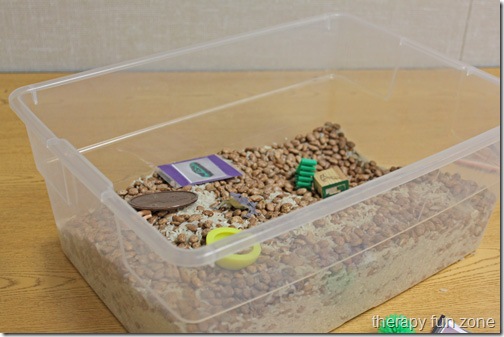
  • Hide the puzzle pieces in a sensory bin*. This activity is an OT favorite. Hide all the puzzle pieces in a deep sensory bin and let the kids dig through to find them. Doing this is a great way to increase fine motor skills, fine motor strength, discrimination, tactile awareness, and  tactile tolerance. To add extra difficulty, do the sensory bin search blind-folded!

*To make a sensory bin place uncooked beans, rice, or both in a deep container that can be re-sealed. The more rice/beans in the container, the harder it will be to find the puzzle pieces. There will be digging and playing in the bin, so make sure your container is deep enough not to have a lot of spillage.(I use a clear 58 gallon storage bin in my therapy room, but it can be made smaller.)

toy sensory bin

  • Hide the puzzle pieces around the room. Take the pieces of the puzzle and hide them around the room. You can make them easily visible or hard to find. Doing this will work on gross motor planning, problem solving, visual motor skills, visual perceptual skills, and fine motor skills.
  • Obstacle course to retrieve 1 puzzle piece at a time. Place the puzzle pieces at one end of room and empty puzzle board on the other. Make up 3-5 steps for things they have to do to get to the puzzle pieces and go back again. (Ex: 5 jumping jacks, run around couch 1 time, army crawl under cushion/blanket fort, crawl over bean bag, hopscotch, jump on 1 foot, spin 3 times, etc…) Use your imagination, or better yet, your kid’s imagination (safety checks required). Doing this will increase gross motor planning, coordination, fine motor, visual motor, muscle strengthening, problem solving, beginning and ending tasks, and it’s going to get some much needed energy out!

Michelle Higginson OTR/L Pediatric Occupational Therapist