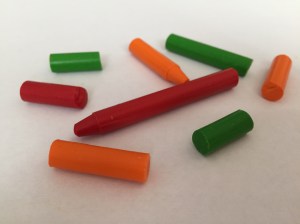
Every family has broken crayons in their house, but no one ever wants to use them and they end up being thrown out. As a pediatric Occupational Therapist that specializes in writing and fine motor development, I want to share with you that broken crayons are actually some of the best tools to use to develop a proper handwriting grasp pattern!
To describe how broken crayons help, we will need to first go over basic grasp pattern development.
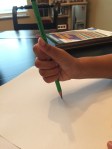
We start holding writing utensils at 12-18 months old with a Palmar Supinate or Fisted grasp pattern, which is where you wrap all your fingers around the crayon, with your thumb on the top.
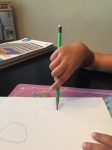
At 2-3 years old we move to a Digital Pronate grasp pattern, where we still have all our fingers around the crayon, but our thumb is at the bottom, closest to the paper.
At 3.5-4 years old, we move into our more normal writing grasp patterns, the quadruped or tripod hold.
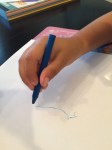
The Quadruped hold is an acceptable hold where the thumb is across from the pointer and middle finger and rests on the ring finger.
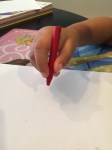
Our ideal and most functional hold is the Tripod hold, where the thumb is across from the pointer and resting on the middle finger. It allows writing with the most function and least effort.
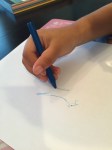
A grasp pattern which we want to discourage, is a Thumb Overlap.
This is the same hold as before, but instead of the thumb being across from the pointer finger, it overlaps it. Although we can have control with that, it leads to decreased writing endurance and can cause a lot of hand pain.
Back to the crayons!
Using a full size crayon or pencil, we can keep all our fingers on it and continue with an immature grasp pattern. With a smaller crayon we have less room, and in turn can only hold with a minimum amount of fingers, forcing us into a quadruped or tripod grasp pattern. Also, because the broken crayon is smaller, to control it better, we automatically bring our thumb back across from the fingers, decreasing thumb overlapping.
So, in summary, broken crayons can actually increase your kiddo’s handwriting skills!
*** Note: You don’t want to force your child to use a specific grasp pattern if they are not ready. Instead we need to provide them with activities or props that will help them develop it on their own. Otherwise you can actually set them back with their writing skills. If you are concerned about their pencil grip, talk to you Doctor about an Occupational Therapy consult to help them develop the fine motor skills and strength to develop a better pencil grasp.
In case you have too many broken crayons or your child has mastered their grasp patterns, here are a few more ideas for what to do with broken crayons.
–Baking crayons in cupcake tins. You can take your broken crayons and bake them in cupcake tins to form new crayon shapes. For detailed instructions on how to do this, click here.
–Making artwork with melted crayons. Very creative and beautiful artwork can be made by gluing your crayons onto a canvas and melting them with a hairdryer. For detailed instructions on this, click here.
–Making crayon candles. You can add broken crayons to candle wax and melt them, creating beautiful and colorful candles. For detailed instructions, click here.
Make a simple crayon holder that not only stores crayons safely, but works on fine motor and visual motor skills.
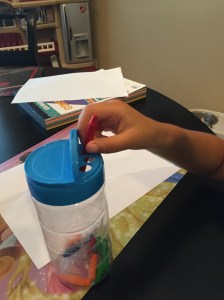
1- Take an empty plastic parmesan cheese container and wash it out.
2- Remove labels.
3- Let your child decorate with stickers and paint.
That is it!
Children place their crayons through one of the three holes on top. Placing the crayons in the hole works on hand eye coordination, fine motor, and grasping skills. To empty the container, just unscrew top.
Younger kids love this holder too, and you would be surprised how entertained the can become with this simple activity!
I hope this has provided you with some insight into handwriting grasping skills and the fact that broken crayons can assist in grasp development. If you have any further questions regarding grasp patterns or broken crayons, please feel free to message me.
Thank You!

 The OT Toy Stretcher