

Kids grow out of simple puzzles pretty quickly, but almost everyone has one in their house. Having these are good because they work on fine motor coordination and visual motor skills, which are all important skills needed for dexterity, coordination, and handwriting development.
Here are a few ideas on how to extend their play life:
- Do the puzzle blind-folded. Without vision, children will need to rely on their sense of touch and discrimination to find the correct holes and puzzle pieces. Doing this will address their fine motor skills, dexterity, tactile discrimination, and problem-solving skills.
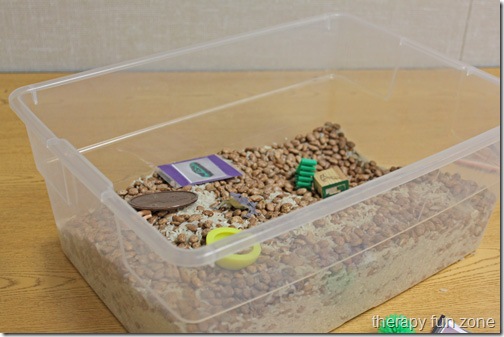
- Hide the puzzle pieces in a sensory bin*. This activity is an OT favorite. Hide all the puzzle pieces in a deep sensory bin and let the kids dig through to find them. Doing this is a great way to increase fine motor skills, fine motor strength, discrimination, tactile awareness, and tactile tolerance. To add extra difficulty, do the sensory bin search blind-folded!
*To make a sensory bin place uncooked beans, rice, or both in a deep container that can be re-sealed. The more rice/beans in the container, the harder it will be to find the puzzle pieces. There will be digging and playing in the bin, so make sure your container is deep enough not to have a lot of spillage.(I use a clear 58 gallon storage bin in my therapy room, but it can be made smaller.)
- Hide the puzzle pieces around the room. Take the pieces of the puzzle and hide them around the room. You can make them easily visible or hard to find. Doing this will work on gross motor planning, problem solving, visual motor skills, visual perceptual skills, and fine motor skills.
- Obstacle course to retrieve 1 puzzle piece at a time. Place the puzzle pieces at one end of room and empty puzzle board on the other. Make up 3-5 steps for things they have to do to get to the puzzle pieces and go back again. (Ex: 5 jumping jacks, run around couch 1 time, army crawl under cushion/blanket fort, crawl over bean bag, hopscotch, jump on 1 foot, spin 3 times, etc…) Use your imagination, or better yet, your kid’s imagination (safety checks required). Doing this will increase gross motor planning, coordination, fine motor, visual motor, muscle strengthening, problem solving, beginning and ending tasks, and it’s going to get some much needed energy out!
Michelle Higginson OTR/L Pediatric Occupational Therapist
 The OT Toy Stretcher